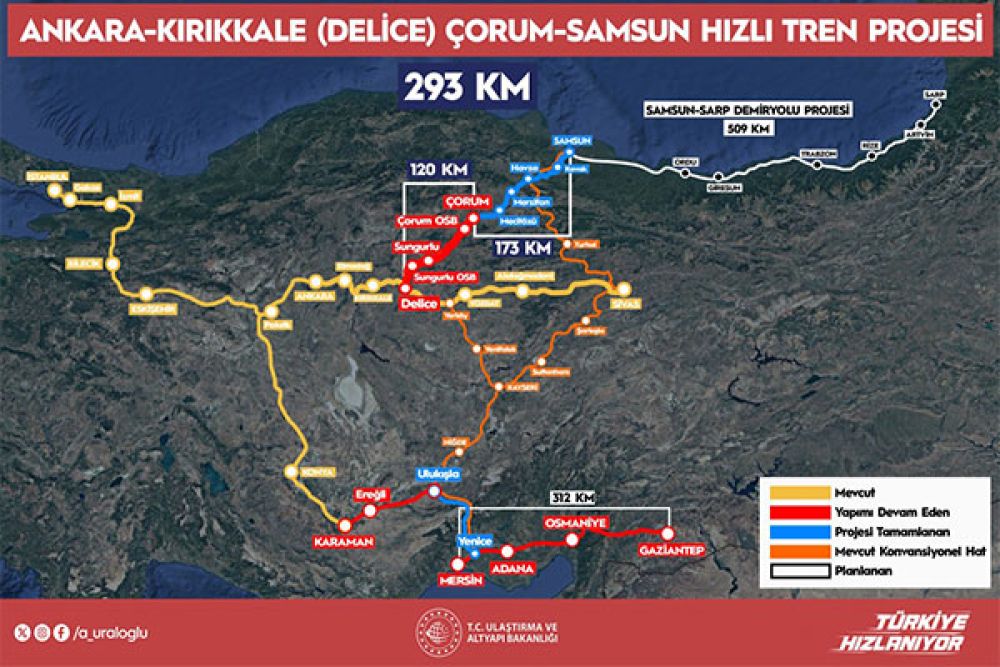
A new 120-kilometre high-speed rail section in northern Türkiye is a part of a larger, 293-kilometre corridor, connecting the capital Ankara with the Black Sea port of Samsun.
New corridor to connect central Anatolia and the Black Sea
The Ankara–Kırıkkale–Çorum–Samsun high-speed line is intended to create a direct north-south axis for both passenger and freight traffic. Once completed, the entire corridor will reduce travel time between Ankara and Samsun to 2.5 hours. Passenger forecasts estimate up to 12 million people per year, with an annual freight capacity of 14 million tonnes.
The new route extends an existing 121.7-kilometre high-speed segment already operational between Ankara and Delice, originally part of the broader Ankara–Sivas high-speed line. The Delice–Çorum–Merzifon–Samsun extension is designed for a maximum operating speed of 200 km/h.
Infrastructure timeline and design elements
Construction on the Delice–Çorum segment is scheduled for completion by the end of 2029. Once operational, the travel time between Çorum and Ankara will be cut to 1 hour and 15 minutes. The line is designed with five stations and features 8 bored tunnels, 3 cut-and-cover tunnels, 26 bridges and viaducts, 16 overpasses, 84 underpasses, and 208 culverts.
Beyond rail transport, the corridor is expected to shift regional logistics patterns by linking inland production zones with Samsun on the Black Sea and—through planned southern extensions—with the port of Mersin on the Mediterranean.
Extended vision for turkey’s high-speed network
The Delice–Samsun line forms part of Türkiye’s national railway expansion programme, which targets 17,500 kilometres of track by 2028 and 28,500 kilometres by 2053. Since 2002, the country has invested approximately USD 64 billion (EUR 59.8 billion) in rail infrastructure, adding over 3,000 kilometres of new track—including 2,251 kilometres of high-speed and intercity lines.
The corridor is also intended to alleviate congestion on coastal shipping lanes by providing a parallel inland route for containerised freight. The project integrates with other active construction efforts including high-speed corridors to İzmir, Bursa, Gaziantep, and the Bulgarian border near Kapıkule.
Future connections to the eastern Black Sea
In parallel, planning is underway for a 509-kilometre rail extension along the eastern Black Sea coast, which would connect Samsun to Sarp near the Georgian border via cities such as Ordu, Giresun, Trabzon, and Rize. These would be integrated into the same Ankara-centred high-speed network.
With completion of all planned segments to Mersin and beyond, the line is expected to directly serve 8 million residents. Turkish authorities envision a national grid allowing full high-speed access across the country within 48 hours by 2053.