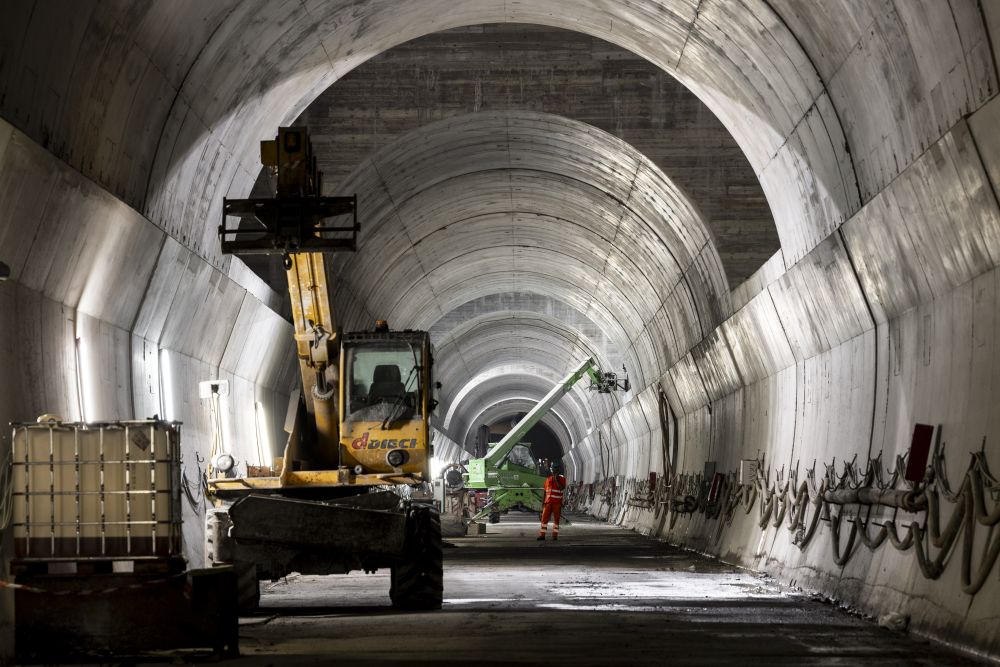
The tunnel, running beneath and between the two future main railway tubes, is part of the Brenner Base Tunnel (BBT) project and has been under construction since December 2007.
The completion was marked on 18 September 2025 during an official event in Brenner. The exploratory tunnel serves as a geotechnical investigation corridor, helping to assess rock conditions and reduce risks during the construction of the main tubes. Once the BBT is operational, the tunnel will also be used for drainage, technical systems, and maintenance access.
With this step, excavation of all planned tunnels on the Italian side has now been finalized. As of August 2025, 88% of the tunnel excavation work across the project has been completed.
Construction sites overview
Of the seven construction sites along the BBT alignment, three remain active. Excavation progress varies by section:
- Lot H71 (Isarco underpass): Completed in December 2023, connecting the BBT to the existing Brenner railway line near Fortezza. Included 4.5 km of main tunnels and 1.2 km of connecting infrastructure.
- Lot H52 (Hochstegen): Delivered 4.8 km of tunnels in total, including exploratory, main, connecting tunnels and cross-passages, completed in December 2023.
- Lot H33 (Tulfes–Pfons): Completed in September 2021 with 43.3 km of tunnel excavation including the emergency, main, and exploratory tunnels.
- Lot H21 (Sill Gorge): Finalised in December 2024. This section links the northern BBT portal to Innsbruck central station.
- Lot H61 (Mules 2–3): Began in 2011 and concluded excavation in August 2025. The section includes 65 km of main tunnels, exploratory tube, crosscuts and an access tunnel. Final lining works are in progress.
- Lot H41 (Sill Gorge–Pfons): Under construction since January 2022, this lot includes 22.5 km of main tunnels and 2.3 km of cross-passages. Tunnel boring machines ‘Ida’ and ‘Lilia’ have passed the halfway mark.
- Lot H53 (Pfons–Brenner): Excavation started in May 2023. TBMs ‘Wilma’ and ‘Olga’ began driving northwards in September 2024. This lot involves 25.2 km of main tunnels, 1.6 km of exploratory tube and 2.6 km of cross-passages.
EU eunding
The Brenner Base Tunnel has received long-term support through EU transport funding programmes. By the end of 2025, the total EU contribution is projected to reach EUR 2.3 billion, equivalent to approximately 2.3 billion in local currency.
What is the project about
The BBT aims to improve rail connections through the Alps on the Munich–Verona axis, which forms part of the Scandinavian–Mediterranean TEN-T corridor. The existing Brenner railway, dating back to 1860, climbs steep gradients and restricts train speed and loading capacity. The new tunnel will run almost flat beneath the Brenner Pass at a maximum gradient of 7‰.
When completed, the 64 km twin-tube structure will be the longest railway tunnel in the world. It will shorten the Fortezza–Innsbruck route by around 20 km and is expected to reduce travel times from 80 to 25 minutes for passenger trains, depending on operational speeds.
Each single-track tube will have an internal diameter of 8.1 metres and be spaced 40 to 70 metres apart. Safety connections between the two tubes are placed at 333-metre intervals. The tunnel will integrate into existing networks via Fortezza in the south and the Innsbruck bypass and Lower Inn Valley railway in the north.