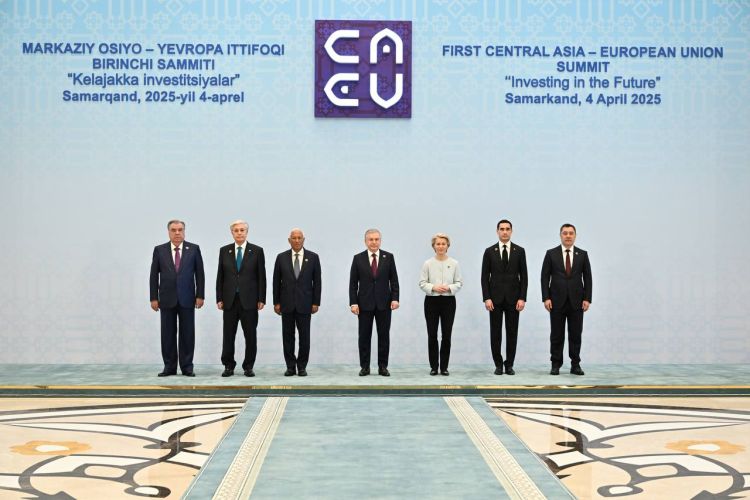
The first Central Asia-EU Summit, held in the Uzbek city of Samarkand on April 4 and chaired by Uzbek President Shavkat Mirziyoyev, brought together the leaders of all five Central Asian republics, top EU officials, and heads of European financial institutions to chart a course for deeper political and economic cooperation.
Key themes included transport connectivity, particularly rail. President Mirziyoyev identified the lack of efficient transport corridors as the main obstacle in developing cooperation with leading European companies.
"In particular, we need to develop coordinated measures and business-friendly conditions for expanding and loading the Middle Corridor. I am confident that these tasks fully correspond to the goals of the pan-European Global Gateway strategy. In this regard, we propose to convene a meeting of transport ministers from the countries along this route under the auspices of the European Union to develop coordinated approaches," said Mirziyoyev.
Mirziyoyev stressed that the development and optimization of this corridor are essential to unlocking trade potential and integrating Central Asian economies with European markets. He suggested convening a special meeting of transport ministers from the corridor countries to coordinate improvements, focusing on removing infrastructure bottlenecks, harmonizing customs procedures, and ensuring multimodal compatibility.
European Commission President Ursula von der Leyen echoed this emphasis on connectivity, announcing a €12 billion Global Gateway investment package, part of which is expected to support sustainable transport infrastructure and cross-border logistics development. The European Commission has positioned the Middle Corridor as a priority under its Global Gateway strategy, seeing it as a viable alternative to traditional Eurasian routes.
The EU's increased engagement - and Central Asia's rapid economic growth - signal increasing opportunities for rail operators and infrastructure developers. With long-term plans to streamline transit and expand trade links, rail will play a key role in this evolving inter-regional partnership.