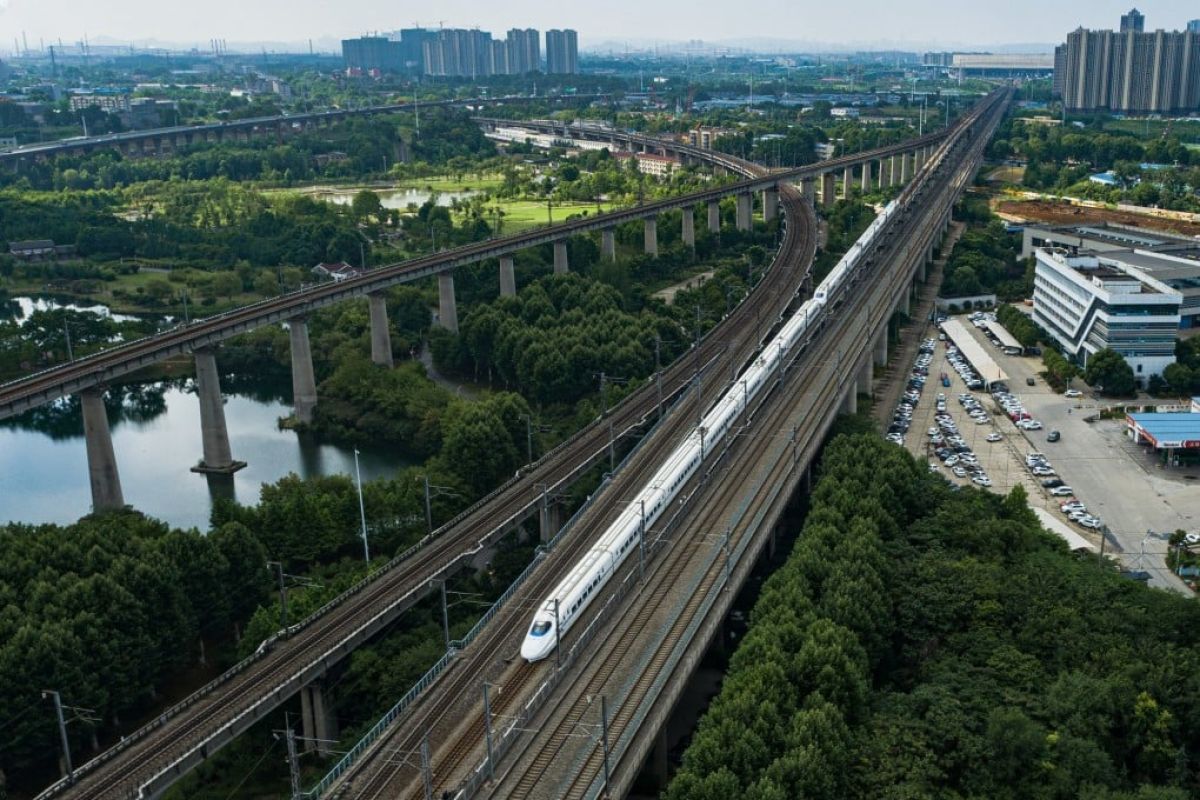
China has deployed an artificial intelligence system to choose the excavation methods for the Yangcun Tunnel, part of a 350 km/h high-speed rail line being built in Hubei province. According to reporting by the South China Morning Post, it is the first time worldwide that the main construction approach for a high-speed rail tunnel was determined by AI before being approved and executed by human engineers.
The tunnel crosses one of China’s most geologically complex regions, marked by fault lines, karst formations, underground rivers and highly variable rock layers. Traditionally, selecting the right excavation method — such as full-face blasting, bench cutting or the CD (centre diaphragm) method — has been the responsibility of veteran tunnel experts. In this case, however, the decision came from a deep-learning model trained on decades of engineering data.
AI trained on thousands of tunnel sections
Researchers from China Railway Siyuan, the National & Local Joint Engineering Research Centre of Underwater Tunnelling Technology, and the China University of Geosciences (Wuhan) trained the algorithm on 1,700 construction sections from 251 high-speed rail tunnels across China. Each entry included detailed geological and engineering parameters, allowing the model to recognise patterns and assess risks.
When fed real-time geological data from the Yangcun route, the AI divided the tunnel into hundreds of micro-sections and assigned a recommended excavation method to each — including high-risk CD-method zones that are difficult to predict manually. According to a peer-reviewed study cited by the South China Morning Post, the model achieved 89.41% accuracy, outperforming conventional machine-learning techniques.
Engineers approved and implemented the AI plan
The AI’s proposals were reviewed by senior engineers before being incorporated into the tunnel’s building information modelling (BIM) system, where they now serve as real-time guidance for workers and machinery.
A glimpse of future engineering workflows
While Western firms often treat AI as a separate experimental tool, Chinese infrastructure companies are increasingly integrating AI directly into design and construction workflows. The Yangcun Tunnel showcases how AI can support high-stakes engineering decisions traditionally considered too complex for automation.
The project is seen as a milestone in China’s expanding use of AI in large-scale infrastructure — and, as the South China Morning Post notes, a potential marker of how the global AI race may evolve in the rail sector.