Freight traffic to and from Sweden is expected to increase by around 30–40% by 2045 following the completion of the Fehmarn Belt fixed link between Denmark and Germany, according to a new system analysis by the Swedish Transport Administration.
The analysis, based on the Swedish Transport Administration’s Samgods freight model, focuses primarily on rail freight flows. In one reference scenario, the volume of goods transported across the Öresund Bridge is around 20% higher in 2045 than it would be without the Fehmarn Belt link, equivalent to roughly 2 million tonnes per year. About 75% of this increase is allocated to the Southern Main Line (Södra stambanan), with the remainder routed via the West Coast Line (Västkustbanan).
Results show that the Fehmarn Belt connection mainly changes routing through Denmark but also generates additional demand for rail freight in southern Sweden. Increased capacity and reduced transit times raise rail’s competitiveness, particularly on the Southern Main Line, where freight flows are forecast to grow more strongly than on parallel routes.
The study highlights capacity constraints within Sweden as the main limiting factor. While the West Coast Line is assessed as having relatively good freight capacity, sections of the Southern Main Line—especially between Hässleholm and Lund—are forecast to reach full utilisation by 2045 if no additional tracks are built. In such a scenario, several million tonnes of freight per year would be displaced to other modes.
With the planned four-tracking of Hässleholm–Lund completed before 2045, the analysis indicates that capacity utilisation for freight on this section could fall below 40%. The bottleneck would then shift north towards Alvesta–Älmhult, where utilisation is projected to peak, pointing to a need for further long-term capacity measures on the Southern Main Line, including proposed passing-loop packages north of Älmhult included in Sweden’s draft national plan for 2026–2037.
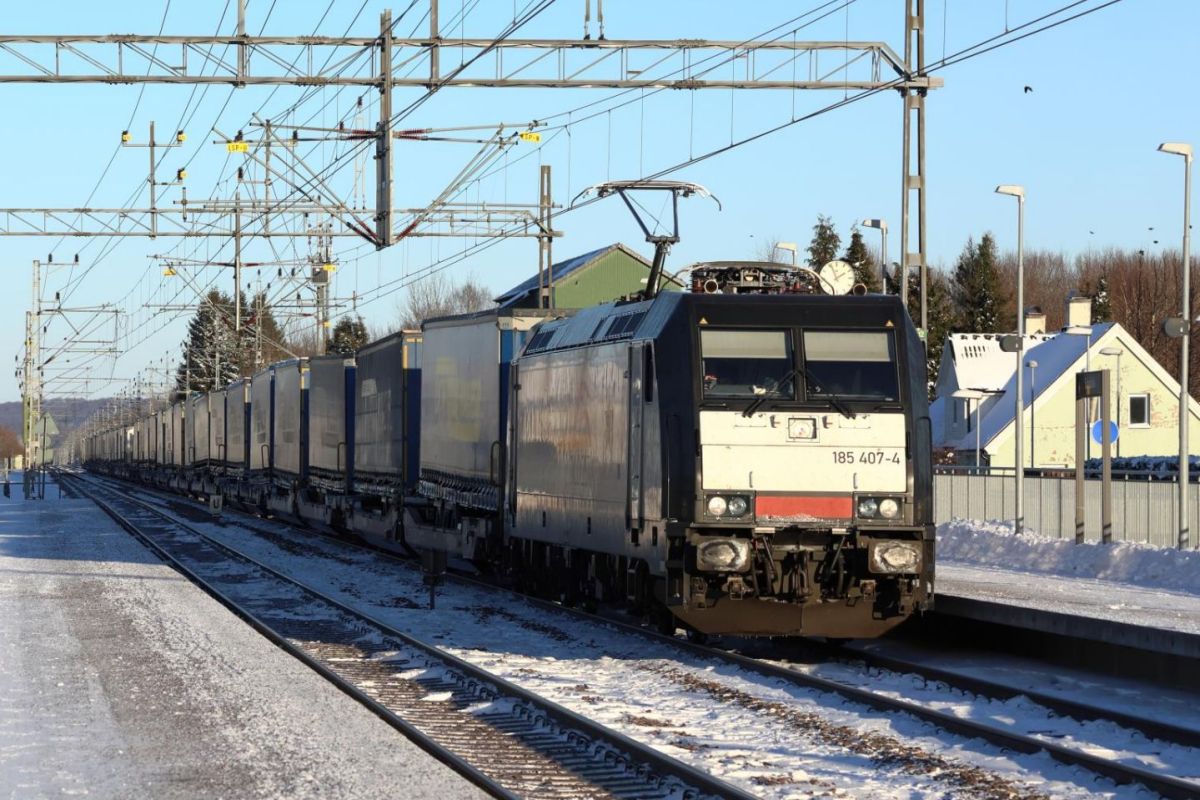
Across the Öresund Bridge, the number of freight trains is forecast to increase from around 35 per day in 2019 to approximately 50 per day in 2045, an increase of just over 40%. The Fehmarn Belt link itself is planned for up to 72 freight trains per day, and even in scenarios with expanded Swedish capacity, utilisation on the Denmark–Germany connection is projected at around 80%, indicating remaining headroom on the cross-border links.
Road freight is also expected to grow, though less sharply across the Öresund. Heavy truck traffic over the bridge is forecast to increase by just over 30% between 2019 and 2045. Larger increases are concentrated on Sweden’s domestic road network, particularly the E4, with more limited growth on the E6 and across the bridge itself.