The service began in March 2025 and connects Komatsu’s Awazu plant in Ishikawa Prefecture with the company’s Ibaraki factory, covering approximately 600 km.
Joint project with JR Freight, Nippon Express, and Komatsu Logistics
The transport scheme is operated in collaboration with Komatsu Logistics (a Komatsu subsidiary), Japan Freight Railway Company (JR Freight), and Nippon Express. The goal is to shift long-distance cargo from road to rail, especially where existing container specifications previously limited modal shift due to weight and size constraints.
Until now, some parts produced at Awazu, such as transmissions, were transported using a combination of rail and long-distance trucking. This was due to standard container restrictions, particularly a 5-ton weight limit. In 2024, the four companies formed the “Awazu–Kanto Modal Shift Committee” to address the issue and received project certification under Japan’s Freight Logistics Efficiency Act.
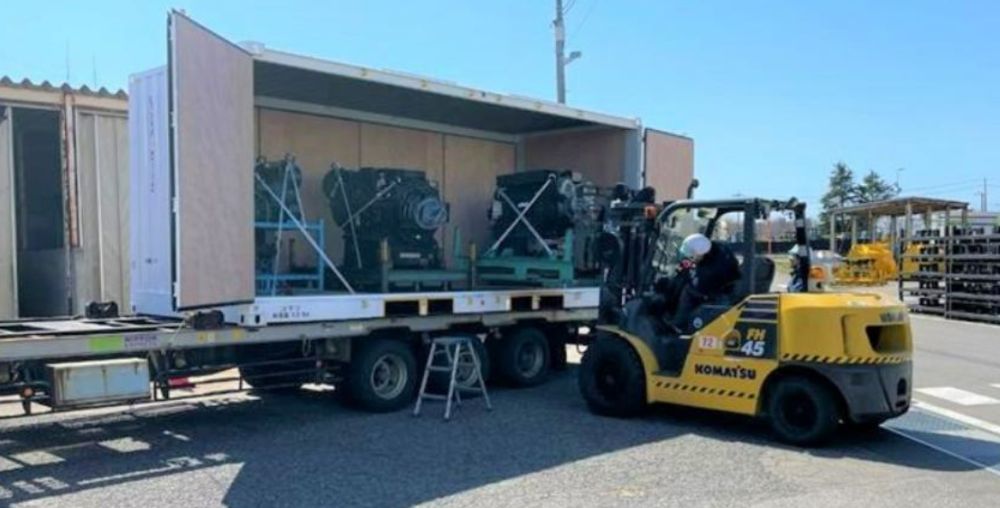
The project was also selected for the 2024 fiscal year’s emergency modal shift acceleration initiative. Komatsu introduced six newly designed 20-foot containers for this purpose. These containers allow a maximum payload of up to 10 tonnes, doubling the weight capacity compared to standard domestic containers.
How the transport chain looks like
The containers are tailored to the specifications of construction and mining equipment components and are operated directly by Komatsu. The transport chain starts at the Awazu plant, from which containers are trucked to the Kanazawa freight terminal, loaded onto JR Freight wagons, and moved by rail to Mito ORS (Off-Rail Station), where they are again transferred to trucks for final delivery to the Ibaraki plant.
A visual diagram on page 2 of the document illustrates this logistics flow, showing the container transfer points and modes between Komatsu’s Awazu and Ibaraki factories.
Not the first rail logistics project for Komatsu
Komatsu has already implemented rail-based modal shift since May 2018 on other domestic routes. These include shipments between the Oyama plant (engine and hydraulic equipment) and the Awazu plant (small and medium-sized construction machinery), as well as between the Koriyama plant (hydraulic cylinders) and the Osaka plant (medium and large-sized construction equipment).