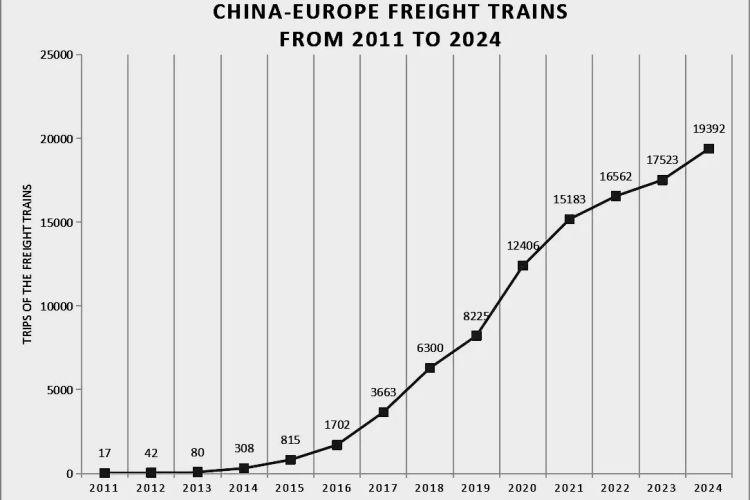
Of these, 10.546 were outbound to Europe and 8.846 were inbound to China.
"These figures are correct, but we must be aware that China counts Russia as Europe," says Senior Consultant Alexander Labinsky from SCI Verkehr and continues: "According to European and Russian statistics, the volumes transported between China and the European standard gauge network have decreased since the outbreak of the war in Ukraine. And it is not clear how big the number of container trains is, when a large part of it is probably coal and oil trains to and from Russia."
As shown in the graph below, Xi’an (3.849 train operation trips), Chengdu (2.285 trips), Chongqing (2.059 trips), and Zhengzhou (2.052 trips) are still the cities with the largest number of China-Europe train trips.
Xi’an achieved a 12.1% year-on-year increase in the number of trains with stable growth, further consolidating its role as a hub.
Compared with other cities, Xi’an, Chengdu, Chongqing and Zhengzhou continue to maintain a considerable advantage in the number of train operation trips.

The number of train operation trips in Chengdu increased by 17.8% year on year, overtaking Chongqing. Among the top four cities, three are western cities.
Zhengzhou, located in the central and eastern regions of China, saw a year-on-year increase of 49.2% in outbound trips in 2024.
Finally, Yiwu (812 train operation trips), Changsha (764 trips), Wuhan (742 trips), Guangzhou (742 trips), Shenyang (676 trips), Jinan (653 trips), Shijiazhuang (598 trips) and Hefei (498 trips) are also important platform cities for the China-Europe freight train.
Source: New Silkroad Discovery